




Introduction to the Artist
Henri Matisse was one of the most defining figures in modern painting to transform colour from “decoration” into a structural principle. He expanded the path opened by his Fauvist legacy through an increasingly simplified language of planes, often constructing form not through line, but through the boundaries at which fields of colour meet.
Interior themes, the window threshold, the relationship between model and studio, and decorative surfaces are not merely “subjects” in Matisse’s work, but modes through which painting thinks. During his late period, he established an economy that reduced the details of the world and intensified visual experience: fewer lines, larger fields of colour, and greater silence.
Introduction to the Work and Composition
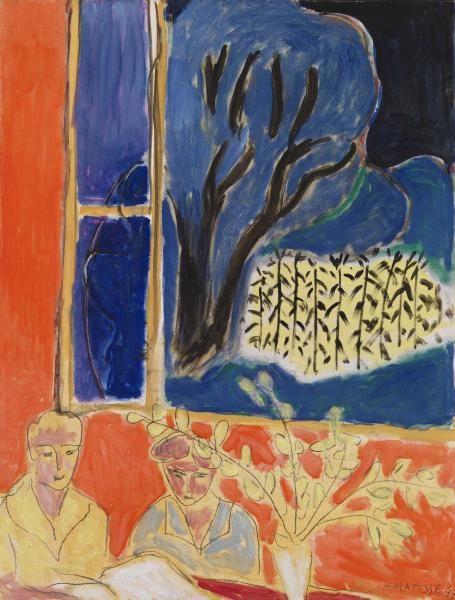
In this painting, the interior expands across the lower section like a coral-red band, while a blue exterior opens above through the window. The window frame establishes a firm yet transparent boundary between inside and outside: the warm interior plane and the cool depth beyond remain side by side without colliding.
Outside, a dark tree silhouette rises within the blue like black writing. On the right, a pale field filled with rhythmic, repeated signs resembling small leaves or shoots constructs less a description of a garden than the sensation of one.
In the lower section, two young girls sit close together yet remain inwardly withdrawn. Their faces and bodies are drawn with an almost sketch-like delicacy. Plant stems and pale lines in the foreground create a fragile transparency upon the coral plane. The fullness of the interior is softened by the vibration of these fine lines.
Three-Level Analysis through Panofsky’s Method
Pre-iconographical Level
The painting shows a coral-red interior surface, a blue window opening, a dark tree form outside, and repeated small signs. Below are the head and shoulder lines of two figures, while vegetal lines appear in the foreground.
The work speaks through surfaces and boundaries rather than volume.
Iconographical Level
Two young girls appear to be reading or bending over a text within the tranquillity of a domestic interior, accompanied by a garden view opening through the window.
The window evokes the familiar theme of “looking outside” in interior painting. Here, however, the gaze circulates among fields of colour rather than observing the landscape.
Iconological Level
The scene foregrounds a fundamental concern of modern painting rather than narrating an ordinary moment: not how the world is represented, but how representation must be constructed for the sensation of a “world” to emerge.
The coral interior and the blue exterior stand beside one another like two distinct climates without directly narrating the fragility of the post-war period. Reading functions less as the acquisition of knowledge than as a refuge and focal point within the image.
The painting operates like a field that disciplines human attention anew.
Representation – Gaze – Void
Representation
Matisse constructs the figures and objects only “to the extent that they remain recognisable,” deliberately withdrawing everything beyond that point.
The window, tree, and garden become less a descriptive landscape than a ground upon which colours support one another. The coral interior does not conflict with the pale lines of the figures, but produces an atmosphere holding them together.
Gaze
The painting avoids establishing an order of spectacle. The eyes of the two young girls do not turn toward the viewer, but close inward toward one another and the page.
The viewer is not placed in a position of possessing the scene. The window opening and the silhouette of the tree continually draw attention outward before returning it to the interior.
Gaze does not penetrate through curiosity. It circulates through rhythm and becomes a calm movement.
Void
The most powerful void is the blue field of the window: a large, nearly uninterrupted area purified of detail and functioning as a space of breath.
This void is not an “absence,” but the painting’s field of thought. The lightness of the figures also produces emptiness. Their bodies appear not through solid volume, but as though emerging from within absence.
Void multiplies silence, and the emotional quality of the scene arises from intervals rather than narrative.
Style – Type – Symbol
Style
The aesthetics of the plane, the bold contrast among fields of colour, and the deliberate delicacy of line are decisive.
The traces of the brush keep the surface alive without making the forms heavy. The separation between interior and exterior is established not through perspective, but through chromatic climates: coral warmth and blue coolness form the structural axis of the composition.
Type
The type of the “reading young girls” belongs to the silent figures of the modern interior. The theatrical weight of modelling is absent, replaced by the lightness of everyday life.
The type of the “window threshold” carries the idea of an exterior completing the interior. Life within is measured through the presence of what lies outside.
Symbol
The coral-red field carries not only warmth, but also a sense of continuity within the inner world. Blue represents the distant and cool openness of the exterior.
The tree silhouette is not a detailed image of nature, but functions like the “sign” of the outside. Its presence transforms the window into a genuine opening.
The plant stems in the foreground create a fine vibration interrupting the interior plane, like a fragile line of life passing through silence.
Explicit Identification of the Art Movement
Modernism: the late planar aesthetics of Matisse’s Fauvist legacy.
Conclusion
The work appears to have been constructed not to narrate a reading scene, but to reveal “how vision becomes calm.”
Representation universalises the scene by reducing detail. Gaze connects the viewer not to exposure, but to rhythm. Void opens the painting’s true depth through the silence of the blue field.
Style becomes a discipline that turns colour into structure; type takes the form of thoughtful interior figures; and symbolism emerges at the coral-blue threshold through the tension between the continuity of the interior and the openness of the world outside.
