




Introduction to the Artist
Jan Sluyters is one of the important figures of Dutch modern painting. He is particularly distinguished by his bold use of color, his approach to simplifying the figure, and his treatment of modern life within a sensory vibration. In his painting, the body often appears not within academic balance but within a new psychological field opened by color. For this reason, the figure in Sluyters is not merely something seen; it becomes a surface carrying light, color, and emotional tone.
Introduction to the Work and Composition
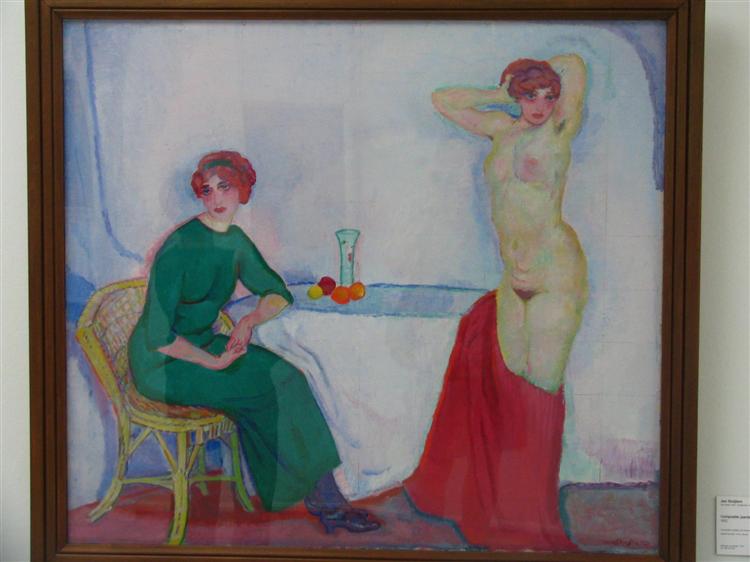
In this painting, two female figures are placed within the same interior but organized through a pronounced structure of contrast. On the left, a woman in a green dress sits on a chair; her body is more enclosed, her gestures more gathered and controlled. On the right, a nude woman stands with both arms raised behind her head, her body rendered in a more open and direct state of visibility. In the lower section, a red cloth or fabric rests against the leg line of the figure on the right; this red field both frames and dramatizes her nudity. Between the two figures stands a table covered with a white cloth, with a slender glass vase and several pieces of fruit. The background is kept largely pale and simple, and this simplicity makes the relationship between the figures more distinct.
The most important aspect of the composition is that the two figures do not touch and are constructed almost like two separate states of mind. The table operates as both a connecting and separating element between them. The seated figure appears closer to the earthly, the everyday, and thought, while the standing nude conveys a stronger sense of openness, visibility, and bodily presence. The painting draws its strength precisely from this duality.
Three-Level Analysis through Panofsky’s Method
Pre-iconographical Level
The painting depicts two female figures, a table, a tablecloth, a glass vase, and several pieces of fruit within an interior. The woman on the left wears a green dress and sits on a chair. The figure on the right is nude, standing with her arms raised behind her head. A field of red fabric appears in the lower section.
Iconographical Level
The title directs the scene toward the duality of “earthly and heavenly love.” The two female figures therefore become not merely two individuals but representations of two different forms of love and existence. The clothed figure may evoke a more worldly, social, and controlled love, while the nude figure may suggest sensual or idealized beauty, openness, and bodily presence. The fruit and vase on the table provide a ceremonial and symbolic middle ground for this encounter.
Iconological Level
The work considers love not as a single emotional unity but as a divided experience. Here, the “earthly” and the “heavenly” are not separated absolutely; instead, they appear as two adjacent figures that do not transform into one another. The painting therefore suggests that love concerns the body, thought, social role, and desire at once. The two figures occupy the same room, but not the same plane of existence.
Representation – Gaze – Void
Representation
Sluyters does not construct the female body within an ideal academic form. The standing nude in particular appears less through soft modeling than as a body that slightly vibrates and dissolves within color. The clothed figure on the left carries a more enclosed mode of representation; her body is concealed within the volume of the dress. The painting thus establishes two different regimes of visibility: one covered, one exposed; one gathered, one free.
Gaze
The two figures do not direct their gazes toward the same place. The seated woman turns more toward the viewer or the foreground, while the standing figure occupies a pose that is more outwardly open yet also conscious of her own body. This arrangement of gazes is important because the painting does not construct an erotic scene between a pair. The viewer is directed not to choose between the figures but to consider the difference between them. The gaze here produces separation rather than union.
Void
The broad and pale background creates a distinct silence around the figures. Rather than deepening the space, this void makes the psychological interval between the two women visible. The table at the center and the light-colored wall surface further emphasize the distance between them. The void is therefore not merely physical space but the invisible difference between two modes of existence.
Style – Type – Symbol
Style
The painting is constructed through a figurative language in which line and color are softened yet clearly modernized. Flesh tones, the green dress, red fabric, and white cloth operate as large chromatic fields. The brushwork is not harsh, yet it does not depend on academic polish. This places the painting at a point that is both elegant and slightly uneasy.
Type
The figure on the left approaches the type of the inward-looking, seated, waiting woman. The figure on the right becomes the type of the nude, standing, visible body. Yet these are not simple oppositions; one is not merely “good” and the other merely “sensual.” The real force lies in the fact that they confront one another without completing each other.
Symbol
The green dress evokes restraint, inward withdrawal, and social appearance. The red fabric intensifies bodily warmth, desire, and visibility. The fruit on the table carries a sense of earthly pleasure and transience, while the slender glass vase adds a more fragile and ceremonial elegance to the composition. The painting thus treats love not merely as emotion but as a symbolic field constructed between body and culture.
Art Movement
The way the figures are constructed according to emotional and symbolic tension rather than natural reality, the psychological field created through color, and the distancing of the bodies from ideal academic order place the work clearly within Expressionism.
Conclusion
Composition (Earthly and Heavenly Love) shows Jan Sluyters constructing, through two female figures, not merely an interior scene but a modern visual reflection on the divided structure of love. The clothed and the nude, the concealed and the exposed, the earthly and the idealized stand side by side without reconciliation. The strength of the work lies in establishing this tension quietly, without accumulating grand symbols, through the poses of the figures and the contrasts of color alone.
