




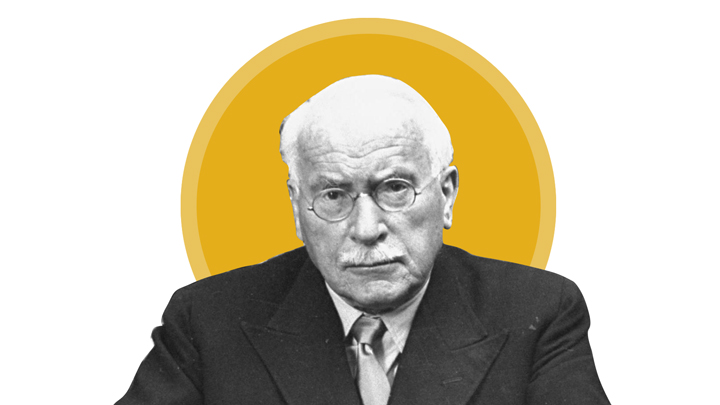
Carl Gustav Jung’s method of active imagination is not based merely on explaining or interpreting unconscious content. The central issue is that psychic contents whose voices are normally unheard by consciousness gain expression and that the individual enters into a direct relationship with them. Dreams, fantasies, moods, and spontaneously emerging images can provide starting points for this relationship. Yet active imagination goes beyond passively observing images that appear in the mind. In Jung’s method, the image is first allowed its own field of movement; consciousness then becomes a participant that assumes responsibility in relation to this movement.
For this reason, the center of active imagination is not the unconscious alone but the relationship between consciousness and the unconscious. The purpose of the method is not for consciousness to seize the repressed or insufficiently heard aspects of the personality. Rather, it seeks to establish reciprocal communication between these two domains. Jung particularly understands psychic elements such as the shadow, anima, and animus—which operate outside the conscious personality—in this context, allowing them to acquire expressions of their own. The unconscious speaks, but consciousness does not remain silent before it.
A Dream with Open Eyes
The first stage of active imagination resembles, in Jung’s description, a dream experienced with open eyes. The process may begin spontaneously or be initiated consciously. A figure appearing in a dream, a fantasy image, or an inexplicable mood may serve as the point of departure. Instead of immediately explaining or eliminating the selected image, the person concentrates attention upon it. What matters here is not redesigning the image through an act of will. The image is allowed to begin moving on its own. As attention is focused upon it, its details may change, new figures may appear, the scene may transform, or the initial mood may take another form. For Jung, precisely this transformation is significant. The change in the image is not the execution of a scenario prepared in advance by consciousness, but the emergence of a field in which psychological movement within the unconscious can find expression.
Jung understands this process as a movement that establishes a connection between consciousness and the unconscious. In the analogy he gives in Mysterium Coniunctionis, the image functions like a waterfall connecting above and below, creating a passage between two psychic domains (Collected Works 14, par. 706). The unconscious does not use direct and conceptual language; it manifests itself in imaginal forms. Active imagination opens a space in which these forms can develop instead of immediately closing them down through conceptualization at the moment they appear.
This process may result in drawing, painting, writing, sculpture, dance, or music. For Jung, however, the value of these products is not primarily aesthetic. Even if the resulting work is never subsequently interpreted, the encounter between the creator and the form they have created may contribute to the transformation of consciousness. Producing a work of art is therefore not the necessary goal of active imagination; creative form becomes the vehicle of a psychic relationship.
The Limit of the Spectator Position
The central difficulty of the method begins in the second stage. Merely observing the movement of images is not sufficient. Jung asks for a transition from a purely perceptual or aesthetic attitude to another position. The person can no longer behave as a neutral spectator of their own inner world.
This distinction explains why active imagination is “active.” In the first stage, unconscious content has been allowed to develop spontaneously; in the second, the person’s own attitude enters the process. One must try to understand what the image says about itself, develop a position in relation to it, and accept the responsibility demanded by the insights that emerge.
Jung compares this to a theatre of the psyche. A person may observe from outside what is happening on the stage, yet at the same time they are one of the actors within that scene. The problem arises when someone believes themselves to be merely an observer without recognizing their role in their own psychic drama. Jung’s example of Parsifal belongs precisely here: Parsifal’s failure to ask the vital question lies in his inability to relate the event before him to his own existence. In active imagination, transformation begins at the moment a person recognizes their own involvement.
The image thereby ceases to be merely an object of observation. The person encounters it, responds to it, objects to it, questions it, or evaluates the demand that comes from it. This encounter means neither surrendering to the unconscious nor allowing consciousness to silence it. The aim is to establish a relationship in which both sides preserve their own positions.
From Image to Responsibility
The defining feature of the second stage of active imagination is therefore its ethical dimension. Jung does not regard it as sufficient for insight gained from images to remain merely an intellectual discovery. The person must confront what they have seen in relation to their own life.
At this point, active imagination differs from a technique that turns the unconscious into an object of curiosity. A person cannot simply find the dark, disturbing, or compensatory content emerging within themselves “interesting.” They must evaluate what it is saying to them. If content coming from the unconscious represents another direction in opposition to the one-sided attitude of consciousness, the aim of active imagination is not to eliminate this opposition but to create a psychological relationship capable of working with it.
What Jung seeks here is not the absorption of unconscious material by consciousness. On the contrary, the compensatory content of the unconscious is to be assimilated by the personality so that a more comprehensive field of meaning can emerge. The image is not merely a disguise for a hidden thought; it may carry an aspect of the personality that has not yet found a place within conscious life. The success of active imagination therefore cannot be measured by how many images a person can produce. What matters is the quality of the relationship established with the image that emerges.
Speaking with the Invisible Partner
One of the clearest forms of Jung’s understanding of active imagination appears in the establishment of a relationship with the anima. When discussing active imagination as one of the ways of becoming acquainted with the nature of the anima, he recommends personifying it as an autonomous personality, directing questions toward it, and listening to its answers. He explicitly states that this is not merely metaphorical language.
In Jung’s formulation, the essence of this art is to “let our invisible partner make its voice heard” (Anima and Animus, Collected Works 7, par. 323 ff.).
The important word here is “partner.” The unconscious is not inert material upon which an operation is performed. It is treated as a psychological reality possessing a certain degree of autonomy in relation to the conscious ego. The possibility of asking questions, waiting for answers, and arguing with those answers reveals the basic structure of active imagination: the person attempts to establish not a monologue but a dialogue with the unknown side of their own psyche.
This dialogue does not absolutize the unconscious. Yet neither does it allow consciousness to regard its own point of view as the only valid reality. The tension established between the image’s own voice and the judgment of consciousness constitutes the creative field of the method.
Conclusion
In Jung, active imagination is not a technique for merely observing images of the unconscious. The first movement is to allow the image to develop itself, but the process does not end there. The person must then become involved in what is happening within their own inner world, speak with the emerging content, and take a position in relation to it. Active imagination therefore avoids two opposite dangers: shaping the unconscious through conscious will and becoming passive before the unconscious. The relationship Jung seeks is established between these two extremes. Consciousness does not abandon its judgment; the unconscious is not reduced to explanations prepared in advance.
The image thus ceases to be a riddle waiting to be solved. It becomes a field of encounter through which aspects of the person that have not yet had a voice can reach consciousness. The transformative force of active imagination arises precisely here: a person does not merely look at their own images; at a certain point, they are also compelled to see their own position before them.
