




Introduction to the Artist
Paul Gauguin was among the artists of late nineteenth-century painting who transformed natural appearance through simplified forms, pronounced contours, and independent fields of color. Dating from 1886–1887, Breton Bather is one of the figure studies from his Brittany period in which he approached the human body between direct observation and formal inquiry.
Brief Introduction to the Work
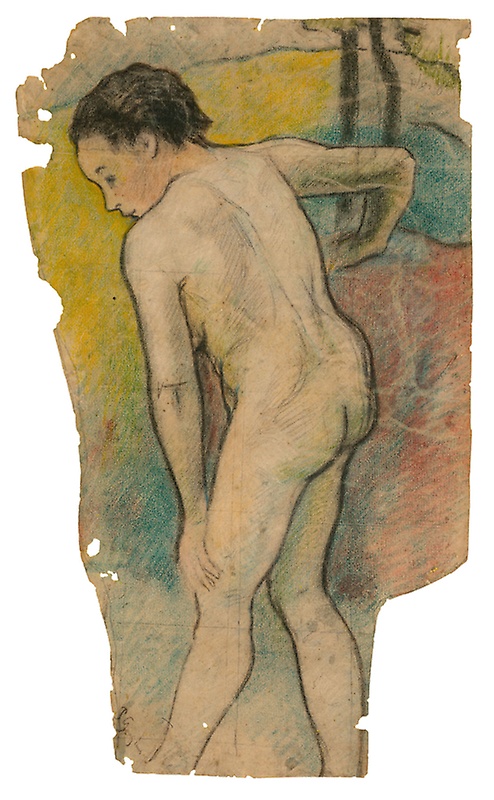
The work shows a nude female figure from the side and with her back turned toward the viewer. Her head is bowed, and her torso bends forward. One arm is folded beside her body, while her other hand rests upon her knee. The posture suggests a moment of preparation, bathing, or the attempt to establish bodily balance, yet no definite action is explained.
The figure’s face does not possess the quality of a detailed portrait. The inclination of the head, the closure of the shoulders, and the closeness of the legs distance the body from an academic nude pose presented outwardly. The woman establishes no relationship with the viewer; she remains absorbed within her own movement and bodily attention.
Lines define the volume of the body, while fields of yellow, turquoise, pink, and gray create a restrained space around the figure. The background does not develop into a detailed interior or coastal view. The colors divide the surface surrounding the body and bring the figure’s movement to the foreground. The irregular and worn edges of the paper further strengthen the work’s character as a direct figure study rather than a completed scene.
Explicit Identification of the Art Movement
The work should be evaluated within the context of Post-Impressionism. Rather than completing the body through the smoothness of academic modeling, Gauguin constructs it through line, simplified volume, and independent color surfaces. Natural appearance is not entirely abandoned, yet the figure’s movement becomes more decisive than detailed realism.
Conclusion
Breton Bather does not present the nude female body within the static mold of ideal beauty. The bowed head, closing torso, and limbs searching for balance record a brief and transient movement. The power of the work arises not from narrative or symbolic intensity but from its simple linear construction, which carries the body’s own weight and direction.
