




Introduction to the Artist
Paul Gauguin (1848–1903) is a key figure of Post-Impressionism who broke away from Impressionist naturalism and moved toward a Synthetist language based on cloisonné-like line, flat areas of color, and symbolic color. His departure for Tahiti in 1891 led both to the simplification of his visual language around planes and patches and to the development of the cultural fantasy he described as “primitive/essential.” The moral and political shadow of this process is considerable: the colonial context, his relationships with underage Indigenous girls, and the exotic narrative he constructed in Noa Noa make it necessary today to approach these works with critical distance. Spirit of the Dead Watching is one of the most intense and, at the same time, most controversial works of his first Tahitian period.
Introduction to the Work and Composition Analysis
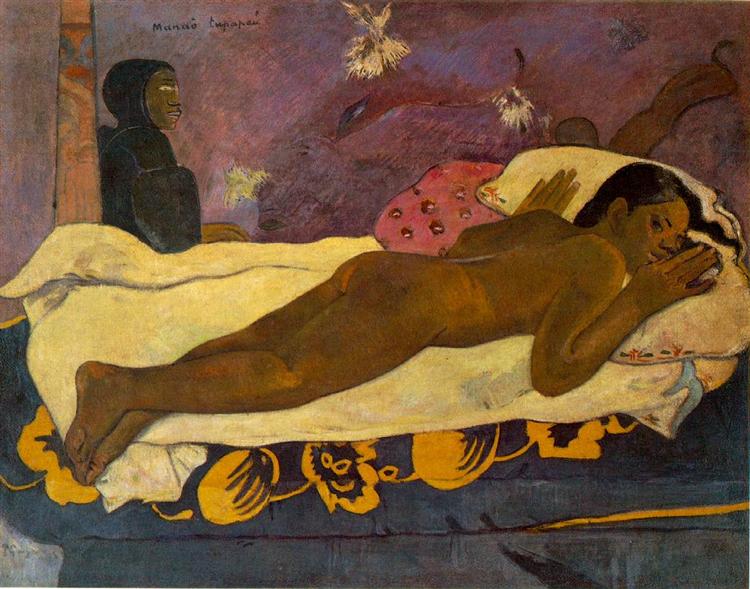
A young girl—probably Teha’amana—lies face down on a bed and turns her head toward the viewer; her eyes are open and alert. Her skin glows like a warm island between the dark violet-purple wall and the lemon yellow–navy blue patterned covering. At the head of the bed, a black, mask-faced ti’i carved idol stands silently; yellowish-white flowers floating across the purple wall vibrate like “fragments of spirit.” The pillows are softened into pink and white patches; the line is thick and dark; not volume but contour and color speak. The plane of the bed is tilted forward like a stage, while the figure’s elongated silhouette is placed along the diagonal axis of the painting.
Three-Level Analysis through Panofsky’s Method
Pre-iconographical Level
A nude young woman lies face down, resting her head on a pillow and looking to the side; on the left is a dark idol or figure; on the rear wall, white flower-like forms float against a purple ground; a dark patterned bed covering lies beneath her. Light brings the yellow covering and the flesh forward; the space is shallow and the perspective compressed.
Iconographical Level
The scene refers to the Tahitian belief in tupapa’u, the spirits of the dead. The Tahitian phrase given by Gauguin, “Manao tupapau,” carries a double meaning: “She thinks of the spirit” or “The spirit thinks of her.” The ti’i at the head of the bed and the floating flower-spark forms on the wall materialize the fear of the night. The bed becomes a local variation on the classical iconography of the “odalisque/nude”; yet instead of erotic relaxation, there is a threshold sensation between sleep and terror.
Iconological Level
Gauguin described the origin of the painting as the moment when, returning at night, he found his young wife terrified and speaking of a “spirit.” On one hand, this account appears to take local belief and fear seriously; on the other, it transforms “Indigenous fear” into an erotic scene through the colonial gaze of a European male painter. The viewer is placed in the same position as the “spirit” lurking at the head of the bed; our gaze therefore enacts what the title declares: the spirit—our gaze—watches. The painting intertwines beauty with terror and sexuality with surveillance; the body of the “other,” celebrated by modern art, becomes both a vehicle for experiments in symbolic color and flatness and a bearer of the asymmetry of power within colonial relations.
Representation – Gaze – Void
Representation
The Synthetist language is entirely explicit. Thick contours lock together broad and almost opaque areas of color; the violet–yellow–navy blue chord establishes a tension between night and fire. The brown of the flesh is painted as a unified field of value, with small warm-cool shifts appearing on the shoulder and hip. The blackness of the ti’i creates the effect of a stone face against the soft curves of the figure; the white flowers on the wall become “splinters of light” through light grazes of the brush. The flattened perspective turns the bed into an icon panel.
Gaze
The girl’s sideways gaze establishes an oblique contact with the viewer; the mask-faced idol does not directly look outward, yet it remains the dark focus of waiting. Three levels of gaze emerge: the figure’s anxious gaze, the stone patience of the idol, and the surveillance of the viewer—the spirit. This triangle transforms the scene from an erotic spectacle into a tense vigil. The title deliberately constructs a play of meaning: “Spirit of the Dead Watching”—who watches whom? Is the girl thinking of the spirit, or is the spirit—us—watching her?
Void
The interior is almost horizonless; the broad negative field of the purple wall clashes with the yellow-navy patterns of the bed covering and compresses the figure. The space does not open outward; the bed is like an island, the wall like a sea at night. This constricted void conveys the suffocation of fear within the room while simultaneously intensifying the stage-like force of the modern flat surface.
Style – Type – Symbol
Type
The nineteenth-century tradition of the “reclining nude” is translated here onto the body of a vahine, a young Tahitian woman; yet instead of the relaxed sweetness of academic odalisques, the figure carries an unease poised at the threshold of sleep and terror. She is not an erotic display but the subject of fear; the gaze she turns toward us allows the anxiety created by the colonial balance of power to enter the scene.
Style
Gauguin uses a Synthetist/Post-Impressionist language: flattening influenced by Japanese prints, thick contours recalling cloisonné, and broad, almost opaque fields of color. The triad of purple wall, yellow/navy covering, and brown flesh constructs a sentence of color rather than volume; perspective is compressed, and the plane of the bed tilts forward like an icon panel.
Symbol
The ti’i on the left, a Polynesian ancestral/idol carving, is a material trace of local belief; the purple wall carries the opposition of night/death, while the yellow pattern carries fire/life; the white flower-like traces on the wall become sparks of spirit. The Tahitian title “Manao tupapau” is double in meaning: “She thinks of the spirit” / “The spirit thinks of her.” The entire composition is thus bound to an eros–thanatos dialectic; the figure’s age and the hierarchy within the relationship are felt as an ethical tension within this symbolic network.
Explicit Identification of the Art Movement
The work belongs to the Synthetist-symbolic branch of Post-Impressionism: flat areas of color, thick contour, and a symbolic palette replace natural light and depth. The aesthetic innovation passes through colonial exoticism; reading these two dimensions together explains both the work’s continuing significance and its problem for the present.
Conclusion
Spirit of the Dead Watching brings the revolution of flatness and color in modern painting together with the dark ethical questions of colonial space on a single surface. The triad of bed–wall–idol forms both a visual lock and a knot of meaning: between the intimate warmth of the girl’s body and the cold surveillance of the gaze, sleep and wakefulness, desire and fear continually exchange places. Gauguin’s painting is as disturbing as it is a masterpiece; precisely for that reason, its contemporary reading must be not only aesthetic but critical.
