




Introduction to the Artist
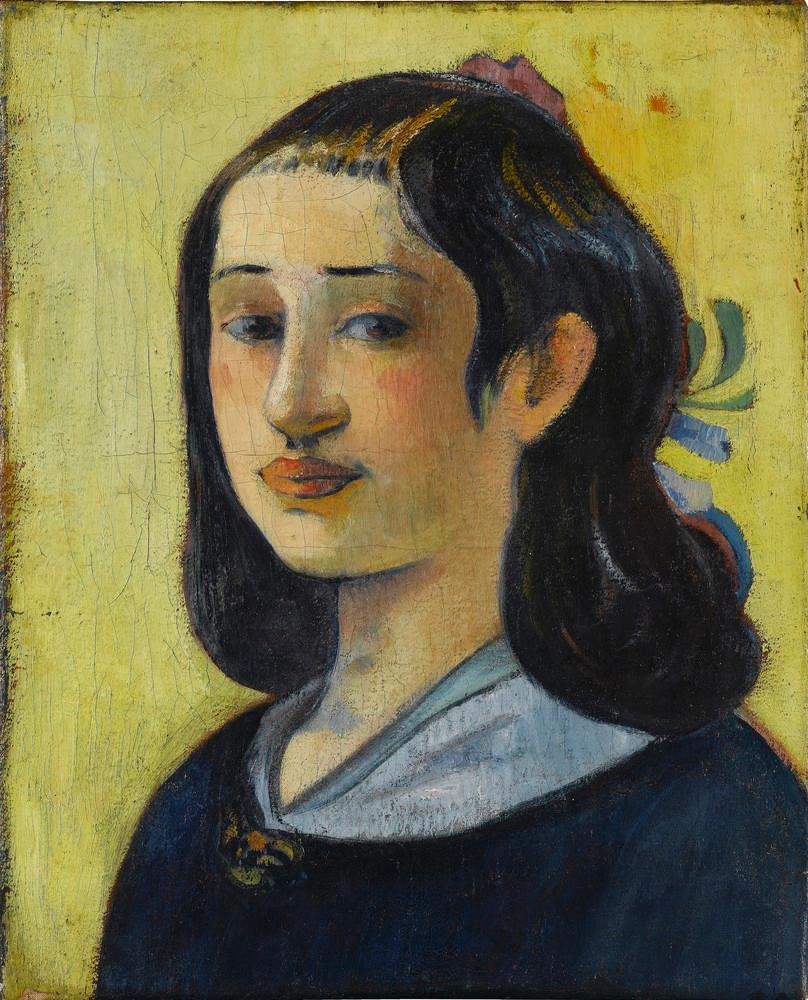
Paul Gauguin was among the Post-Impressionist artists who preserved physical resemblance in portraiture while reconstructing the face through color, contour, and flat pictorial surfaces. In this portrait, dated to approximately 1893, the artist’s mother, Aline Gauguin, is depicted with the appearance of her youth, nearly twenty-five years after her death.
Brief Introduction to the Work
The composition consists of a young woman shown from the shoulders upward against a yellow-green background. Aline Gauguin’s dark hair is gathered into heavy, curving masses on either side of her head and tied at the nape with colored ribbons. Her dark blue garment and pale gray collar create a restrained frame around the face.
The figure does not look directly toward the viewer. Her head is turned slightly to the side, and her eyes are directed along the same line toward an indeterminate point beyond the painting. The thin eyebrows, closed lips, and heavy eyelids distance the face from the explicit expression of any particular emotion. The portrait therefore holds the figure within a calm, measured, and distant appearance rather than explaining her personality through a dramatic gesture.
Gauguin does not treat the face through detailed academic modeling. Green, yellow, pink, and bluish tones move across the skin, while dark contours clearly define the boundaries of the hair, face, and clothing. The background describes no particular setting; it remains a broad field of color separating the figure from time and environment. The portrait therefore carries not only the person’s external appearance but also an image of the mother reconstructed within Gauguin’s memory.
Explicit Identification of the Art Movement
The work should be evaluated within the context of Post-Impressionism. The departure of the face from natural color, the construction of volume through broad surfaces rather than subtle tonal transitions, and the transformation of the background from a descriptive space into a field of color support this classification. Gauguin turns the portrait from a direct record of observation into a personal image shaped through color and memory.
Conclusion
The Artist’s Mother is less an immediate portrait made before a living model than the reconstruction of a face belonging to the past. The yellow background, the dark mass of hair, and the gaze turned to the side remove the figure from everyday time. Gauguin paints his mother not merely as a remembered person but as a silent presence simplified and intensified by memory.
