




Introduction to the Artist
Suzanne Valadon (1865–1938) transformed a career that began as a model in Montmartre into that of a painter who knew the female body from within. Working within a Post-Impressionist language, she used thick contours, flat yet vibrating color, and decorative backgrounds. In Valadon’s nudes, the woman becomes less an object being viewed than a subject who looks; formal hardness and the weight of everyday reality meet on the same surface. The 1920s mark the period in which the artist was most confident, restrained, yet effective in both nude and portrait painting.
Introduction to the Work and Composition Analysis
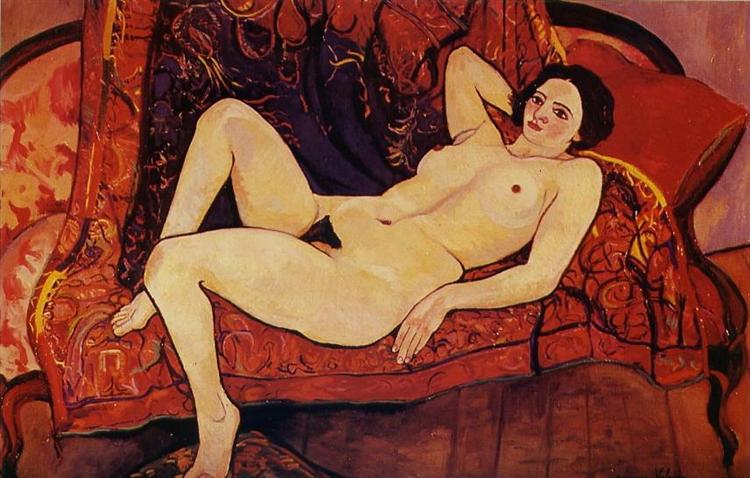
The work depicts a figure reclining across a sofa patterned in dark red and purple, forming diagonal lines through the composition. The left leg extends forward, while the right knee is bent; the left arm is thrown behind the head, and the right hand rests loosely on the hip or thigh. The lips are closed, and the expression is calm. The flesh is painted in blocks of pale pink-beige; volume is constructed not through shadow but through the dark contour that sharply defines its boundaries. The curving patterns and drapery of the sofa upholstery frame the figure almost like a stage; the wooden floor and purple background keep the surface flat. Valadon selectively emphasizes detail: the navel, muscular lines, and dark accent of the pubic area reveal the reality of the body without concealment. The color arrangement is dominated by warm reds; the cooler light of the flesh meets this warmth and pushes the figure forward.
Three-Level Analysis through Panofsky’s Method
Pre-iconographical Level
A nude woman reclines on a red and purple patterned sofa; her head rests backward, her legs are in a relaxed position; a wooden floor is visible; contours are pronounced; broad, flat areas of color dominate.
Iconographical Level
The composition is a modern variation on the “odalisque/reclining nude” type. Yet there are no exotic accessories; the principal elements are the decorative weight of the sofa patterns and the model’s direct gaze. Instead of softened eroticism, there is an everyday and immediate bodily presence.
Iconological Level
Valadon overturns the idealized formula of the “reclining nude” constructed by the male gaze. Rather than displaying herself, the model takes possession of the space; the calm openness of her gaze disrupts the one-sided structure of desire. The body is not perfected; vulnerability and strength become visible at the same time. The painting thus becomes a pictorial declaration of female subjectivity in modern Paris: nudity is not a performance but an unconcealed state of existence.
Representation – Gaze – Void
Representation
Volume is rendered through the decisiveness of line rather than through shadows; color behaves as decorative fields. The sofa is not merely a background but an actor equivalent to the figure; the rhythm of its patterns echoes the curves of the body.
Gaze
The model looks directly at the viewer; eye contact disrupts voyeurism and equalizes the encounter. The stillness of the face and the open posture of the body establish the stance of a subject who is “relaxed yet cautious.”
Void
The background is shallow; the sense of depth comes from the floor line and the curves of the sofa. The narrow intervals between figure and sofa transform negative space into rhythmic breaths; the composition is tight but not oppressive.
Style – Type – Symbol
Style
A Post-Impressionist economy dominates: thick, decisive contour, flat color, and limited modeling. The surface treatment is related to Nabis decorativeness; body and pattern speak through the same pictorial language.
Type
The type is the “reclining nude in an interior”—not mythological, but modern and individualized. The central figure is defined not by accessories but through gesture and gaze.
Symbol
The red and purple fabrics suggest the vitality of the body and the warm possession of the space. The arm thrown behind the head is a sign of confidence and ease; the unconcealed dark emphasis of the pubic area carries a directness that does not hide the reality of the body. The wooden floor seals the domestic reality of the scene.
Explicit Identification of the Art Movement
The work is grounded within Post-Impressionism in a decorative and surface-oriented scheme characteristic of Valadon. Naturalistic chiaroscuro recedes; line and color become equal. The boldness of color inherited from Fauvism and the flattening of the surface associated with the Nabis combine with a modern interpretation of female subjectivity.
Conclusion
Nu au canapé transforms the reclining nude tradition from within. Valadon does not polish the body; she honors its boundaries through thick contour and expands its stage through red patterns. The model’s gaze turns the viewer into the one who is “watching”; the dismantling of hierarchy becomes the painting’s principal dramatic force. The body speaks through the language of ease and possession; nudity becomes the openness of subjectivity.
