




Introduction to the Artist
Suzanne Valadon (1865–1938) was a pioneering painter who brought to painting an “inside knowledge” of the body that entered the canvas, having begun her artistic life as a model in Montmartre. Instead of the academic beauty shaped by the gendered gaze, she painted faces and bodies carrying the weight of life. Within a Post-Impressionist language, she favored thick contours, an economical and assured line, flat yet vibrating fields of color, and decorative backgrounds. The 1910s mark Valadon’s mature phase, when she developed a distinctive honesty and plastic firmness in portraiture and the nude.
Introduction to the Work and Composition Analysis
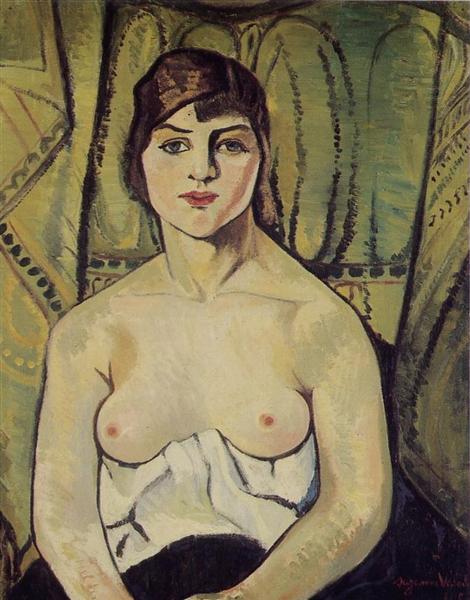
In the painting, the model sits before a green patterned armchair with her chest partially exposed. The flesh is painted in broad patches of warm salmon and beige transitions; darker boundaries around the breasts emphasize volume through thick line. The face is framed by flushed cheeks and short black hair; a dark, sharp brushstroke descending across the forehead—a lock of hair or something resembling a strip of makeup—fixes the gaze on the center of the face. The armchair in the background functions like a decorative curtain through its vegetal motifs and curving seam lines; these stitched lines accompany the rhythm of the contours. The light is homogeneous; instead of dramatic chiaroscuro, brightness spreads evenly across the surface. At chest level, a fold of white fabric establishes a visual threshold between the flesh and the armchair.
Three-Level Analysis through Panofsky’s Method
Pre-iconographical Level
A young woman seated in an armchair; the upper torso exposed; her face turned toward the viewer; a dark strip along the forehead and nose; a green patterned armchair; a limited palette balancing warm and cool tones; pronounced contours.
Iconographical Level
The portrait combines Valadon’s types of the “honest nude” and the “close-up female portrait.” The patterned armchair and white fabric both define the interior and function as decorative elements framing the figure. The dark strip cutting across the forehead is a clear example of the painter’s habit of using line as an “accent”; a single gesture constructs the architecture of the face.
Iconological Level
Valadon overturns the idealizing schemes of the conventional male gaze. She removes the body from its position as the silent object of desire and constructs it as the space of subjectivity: the model looks at us and does not conceal herself; nudity is not spectacle but the simplicity of existence. Thick contours and forceful accents reject sweetened beauty and carry the weight and resilience of female experience. The painting therefore returns “ownership of the gaze” to the model within the everyday reality of modern Paris.
Representation – Gaze – Void
Representation
Volume is constructed through line and blocks of color rather than primarily through shadows. The pattern of the armchair and the contour of the torso speak the same language; the décor is not an “accessory” to the figure but a surface that places itself on equal terms with her.
Gaze
The model looks directly at the viewer; there is no slight smile and no flirtation. This encounter removes the portrait from the realm of erotic consumption and carries it into a subject-to-subject relationship.
Void
The flat, patterned surface of the background suppresses depth; the space between figure and décor becomes flattened. This flatness concentrates attention on the rhythm of face and torso, while the small opening created by the white fabric functions like a breathing space.
Style – Type – Symbol
Style
A Post-Impressionist economy: thick and decisive contour, flat yet vibrating color, visible brushwork, and a decorative background. The “hardness” of the surface is not an absence of emotion but a clarity that creates distance from emotion.
Type
The type is the “close-up, half-nude portrait”; an arrangement that does not erase individuality but draws it toward iconographic simplicity.
Symbol
The black stroke across the forehead and nose evokes a line of identity, even the subject’s act of “marking herself.” The vegetal motifs of the green armchair function like a quiet undertone of vitality and resilience. The fold of white fabric carries the gesture of a threshold between privacy and exposure.
Explicit Identification of the Art Movement
The work stands within Post-Impressionism, along a trajectory related to the decorative surface sensibilities of the Nabis and Fauvism. Surface and linear construction take precedence over naturalistic modeling. Valadon’s distinctive contribution lies in combining this modernist economy with the experience of the female subject.
Conclusion
Portrait of a Woman is a clear example of Valadon’s effort to place female presence at the “center of the gaze” in painting. The warmth of the flesh rests against the cool pattern of the armchair; contour draws the dignity of face and body. The model’s direct gaze turns the portrait into an encounter: we see not an embellished fantasy but a person carrying herself before the world. Valadon gives the female portrait both simplicity and resilience within modernity.
