




Introduction to the Artist
Vincent van Gogh is one of the most powerful figures in modern painting to treat light not merely as an optical event but as an existential atmosphere. His turn toward night scenes during his Arles period is connected to his desire to remove darkness from the condition of “absence” and fill it with color and rhythm. For Van Gogh, night is not the opposite of day but a different form of intensity. Within this intensity, the human being, space, and light intermingle; the painting becomes not a record of a landscape but the emotional topography of living within the night.
Introduction to the Work and Composition
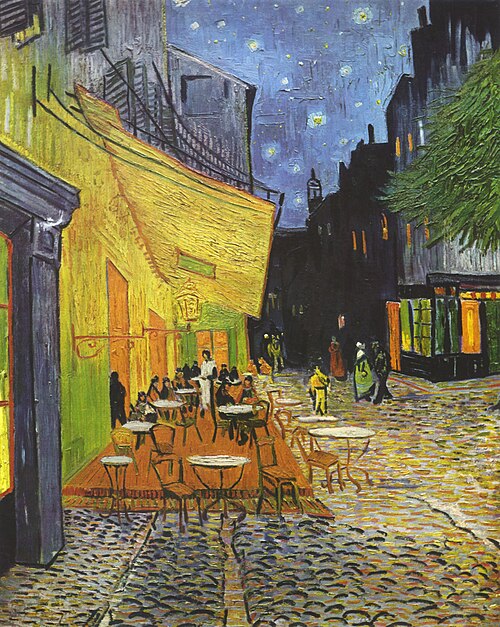
On the left side of the composition, the café terrace appears as a large mass of yellow light. The flat surfaces of the awning and wall project forward together with the tables and chairs; this yellow area is the painting’s principal point of attraction. Small seated and standing figures can be distinguished in the middle section. Their faces are not clearly defined, but their presence gives rhythm and scale to the space. On the right, the street opens into darkness: the building façades rise as dark masses, while small patches of light filtering through the windows intensify the sense of depth. The stone pavement occupies a broad area; the direction of the brushstrokes strengthens the perspective and draws the eye into the street.
Above, the starry sky appears not as a covering that closes the night but as an opening that allows the scene to breathe. The contrast between the yellow light and the blue sky establishes the painting’s fundamental tension: the warm indoor–outdoor space and the cool open air.
Three-Level Analysis through Panofsky’s Method
Pre-iconographical Level
A street and a café terrace are shown at night. There are tables, chairs, and seated people. On the left are an awning and wall illuminated by yellow light; on the right are dark buildings and a street perspective extending into the distance. Stars appear in the sky. The stone pavement is rendered as a textured surface through short brushstrokes.
Iconographical Level
The subject is a night scene from modern urban life: café culture, street life, illumination, and social gathering. The terrace functions as a “semi-interior” within public space; people sit, talk, and wait there. The street and distant figures indicate that nightlife continues. The stars and sky prevent the scene from being limited solely to the city and add a cosmic upper layer: everyday life continues beneath the vastness of the universe.
Iconological Level
The iconological weight of the painting lies not in depicting the darkness of night but in demonstrating that night is a “colored” and “habitable” space. Van Gogh makes visible the social geography constructed by light within the modern city: yellow illumination turns the terrace into a field of attraction, while the blue sky and dark buildings act as boundaries surrounding it. The people are small figures whose faces cannot be distinguished; nevertheless, the true subject of the painting is light. Light organizes the space, gathers the crowd, and opens the depth of the street. The painting therefore carries both the warm and solitary dimensions of modern life: people sit together, yet each figure also carries an individual solitude within the night.
Representation – Gaze – Void
Representation
Representation does more than document a café scene; it shows how light constructs space. The yellow area defines the terrace like an “island,” while the tables and chairs establish the rhythm of this island. The dark street becomes a corridor of movement surrounding it. What is represented is not only a social gathering but also the condition of finding one’s direction within the night.
Gaze
The figures do not look toward the viewer; their gazes are dispersed among the tables, one another, and the movement of the street. This dispersion directs the viewer not toward the psychology of a single face but toward the collective scene constructed by light. The answer to the question “Whom are we looking at?” is not an individual figure but the group gathered beneath the yellow illumination. The perspective lines position us at the edge of the terrace, upon the threshold of light: if we took one step, we would enter the gathering; if we withdrew, we would fall into the darkness of the street. The regime of the gaze operates at this threshold. The brightness inside is inviting yet also establishes a boundary, while the night outside silently draws the eye farther into the distance. Power is concentrated not in the conversations at the tables or in the bodies but in the spatial authority of light; illumination creates an order that both gathers and excludes.
Void
Void appears within the dark field of the sky and the shadowed depth of the street; the bright fullness of the terrace forms the contrasting surface that makes this void visible. The tables and figures compressed beneath the light produce the feeling of a refuge, while the street becomes sparser and opens outward. Yet this openness is not reassuring but uncertain: it makes the night “open” without making it safe. Void therefore creates tension between two different feelings: the terrace is an intimate field protected by light, while the street is a distance extended by darkness whose direction cannot be clearly determined. The sky seals this tension from above. The darkness standing over the brightness does not completely consume the scene’s vitality, but it continually casts upon it a shadow of uncertainty.
Style – Type – Symbol
Style
Van Gogh does not submerge the night in black; he paints darkness through blue, violet, and green tones. The field of yellow light becomes an almost material warmth through thick brushstrokes. The directional marks across the pavement strengthen the perspective, while the contours and color contrasts make the scene vibrate.
Type
The café terrace is a typical space of modern urban life: public space, social encounter, waiting, and transition. Van Gogh does not idealize this type. While constructing the terrace as a “warm island,” he leaves the dark movement of the street immediately beside it. The type therefore becomes a threshold space carrying both sociability and solitude.
Symbol
Yellow light is not merely illumination; it is a symbol possessing the power to gather and call, drawing people inward. The blue sky and stars establish a silent continuity above everyday life and place a cosmic measure over the noise of the city. The depth of the street functions like a road opening toward an unknown future: uncertainty begins where the light ends.
Explicit Identification of the Art Movement
This work should be evaluated within Post-Impressionism. While preserving the observation of light, Van Gogh transforms color and the brushstroke into bearers of emotion and structure, turning the night scene into a field of expression.
Conclusion
Café Terrace at Night demonstrates through the language of painting that night is not merely darkness but a colored space. Representation foregrounds the power of light to construct space; the gaze positions the viewer at the threshold of illumination; void produces an uncertain depth within the sky and the dark street. Style materializes the night through the yellow–blue contrast and vibrating brushstrokes; type transforms the café terrace into a threshold space of modern life; symbols turn light into a call, the stars into a cosmic measure, and the street into the unknown. The painting is not a nocturnal landscape but the visual order of living within the night.
