




Introduction to the Artist
Vincent van Gogh was born in the Netherlands in 1853 and ended his life in the French town of Auvers-sur-Oise in 1890. As one of the most important representatives of Post-Impressionism, Van Gogh used color with symbolic intensity and painted nature through a subjective state of mind, becoming one of the pioneers of modern art. Following the difficult period he experienced in Arles in 1888, he entered the Saint-Paul-de-Mausole asylum in Saint-Rémy-de-Provence in 1889, where for approximately a year he produced numerous paintings devoted both to nature and to the surroundings of the monastery. This painting is one of the important works from that period.
Introduction to the Work and Composition Analysis
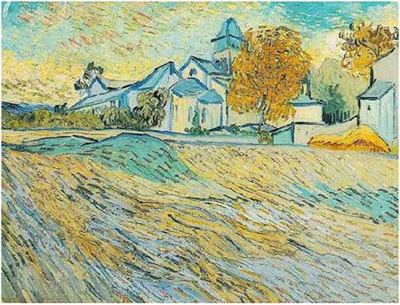
The painting depicts the asylum building and its adjoining chapel together with the rising trees and sky in the background. A broad field extends across the foreground; brushstrokes worked in yellow, green, and blue tones transform the land into a moving, undulating surface.
The buildings are depicted with typical Provençal architecture: white walls, blue roofs, and a rising bell tower. The trees carry an autumnal atmosphere through their yellow and orange leaves. The sky is pale blue and woven with light clouds. Van Gogh’s characteristic curving and directional brushstrokes transform the scene from a static landscape into a rhythmic and almost living experience of nature.
Three-Level Analysis through Panofsky’s Method
Pre-iconographical Level
At first glance, the viewer sees a rural landscape: a field in the foreground, monastery buildings and a chapel in the background, surrounded by trees and sky. The brushstrokes are pronounced, and the colors are intense and bright.
Iconographical Level
This is the Saint-Paul-de-Mausole asylum where Van Gogh received treatment for a period of time. The chapel is not merely an architectural structure but a symbol of the religious and spiritual space in which the artist sought refuge during this period. The undulating fields in the foreground integrate this place with the images of nature that Van Gogh frequently depicted.
Iconological Level
At this level, the painting becomes a visual reflection of Van Gogh’s inner experience. The view of the asylum represents a place in which he was both confined and creatively productive. The curves and rhythms of the brushstrokes reveal his psychological fluctuations. The chapel rises at the center of the landscape as an image of salvation and hope. The painting is therefore not merely a landscape but also a symbol of the tension between spiritual refuge and inner unrest.
Representation – Gaze – Void
At the level of representation, the work is not merely a landscape but a monumental expression of a place that played a decisive role in Van Gogh’s life. The gaze leads the viewer from the field toward the monastery and then upward toward the sky; this vertical movement evokes a spiritual ascent. The void is felt across the broad surface of the field: it becomes a space of both solitude and freedom.
Style – Type – Symbol
Style
A Post-Impressionist style dominates. Thick, directional brushstrokes, intense colors, and the subjective interpretation of nature are typical of Van Gogh’s visual language.
Type
The buildings and field are constructed within the type of a characteristic Provençal landscape. The field carries the type of labor and connection with nature, while the chapel carries the type of spiritual refuge.
Symbol
The field symbolizes the continuity of life; the chapel symbolizes hope and salvation; the undulating brushstrokes symbolize psychological turbulence.
Conclusion
Van Gogh’s View of the Asylum and Chapel at Saint-Rémy is not merely a depiction of a place but also a symbolic painting that bears witness to one of the most intense periods of the artist’s life. Read through Panofsky’s three levels, the work makes visible a historical place, psychological tension, and the search for hope.
The rhythm of Van Gogh’s brushstrokes and the brilliance of his colors transform the landscape into a profound inner experience.
