




There are certain thinkers in the history of philosophy who, by systematically formulating a single concept, open an entirely new field of inquiry both for their contemporaries and for later generations. Alexander Gottlieb Baumgarten (1714–1762) is such a figure. His name is remembered today as the founder of the discipline we know as aesthetics. Reflections on art, beauty, sensation, and taste had of course existed since Antiquity: Plato’s theory of Ideas, Aristotle’s Poetics, the medieval relationship between beauty and divine harmony, the Renaissance conception of mimesis. This entire inheritance had kept art and beauty within philosophy as a dispersed set of concerns. In the eighteenth century, however, at the very centre of Enlightenment thought, Baumgarten for the first time transformed this scattered field into an independent discipline.
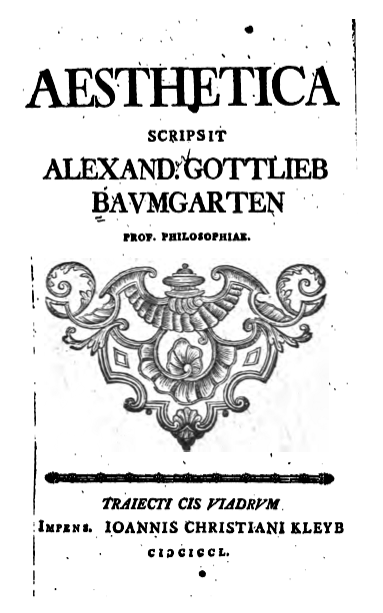
Baumgarten’s Aesthetica, published between 1750 and 1758, was not merely a book but a “foundational text.” With this work, aesthetics was defined as the “science of sensuous cognition.” Philosophy thereby began to attribute systematic value not only to the abstract operations of reason, but also to knowledge obtained through the senses. For Baumgarten, beauty is “what is sensuously perfect.” This definition demonstrates that aesthetics is not limited to the philosophy of art, but also encompasses the sensuous dimension of human knowledge.
This transformation of the concept of aesthetics was not merely an academic innovation, but an important rupture within the structure of philosophy itself. While the rationalist systems of the Enlightenment tended to reduce knowledge to the clear and distinct apprehension of reason, Baumgarten argued that sensuous cognition is also a form of knowledge possessing its own internal coherence. This is where he departs from the rationalist epistemology of Leibniz and Wolff. Sensuous knowledge is not obscure and secondary; within its own sphere, it is systematic, examinable, and valuable. For this reason, Baumgarten’s thought left a powerful legacy that shaped both the philosophy of art and modern aesthetic inquiry.
Baumgarten’s Life and Intellectual Background
Alexander Gottlieb Baumgarten was born on 17 July 1714 in Ruppin, near Berlin. His father was a Protestant clergyman; Baumgarten was orphaned at an early age and continued his education under the supervision of his elder brother Jacob Baumgarten. From childhood onward, he showed an interest in literature and rhetoric, an orientation that points toward the roots of the importance he would later assign to art and poetry within his aesthetic thought.
The University of Halle and Early Influences
Baumgarten’s philosophical education began at the University of Halle in the 1730s. At the time, Halle was emerging as a new intellectual centre in Germany. The philosophy of Christian Wolff dominated the university. Wolff had transformed Leibniz’s rationalist system into a more systematic and teachable form and identified the concept of “science” with the order of reason. Baumgarten was influenced by this tendency at an early age; over time, however, he recognised the limits of Wolff’s rationalist conception and would oppose its neglect of sensuous cognition.
At Halle, the religious movement known as Pietism was also influential. Pietists emphasised personal experience, emotion, and inner depth in religious belief. Baumgarten’s emphasis on sensuous experience moves beyond the Wolffian rationalist framework and also carries traces of this emphasis on feeling. He therefore remained committed to systematic rational thought while at the same time defending the value of sensuous experience, attempting to synthesise these two different orientations.
Academic Career
In 1735, Baumgarten published a short dissertation entitled Meditationes philosophicae de nonnullis ad poema pertinentibus. This work was his first serious attempt to address poetry and aesthetics and quickly attracted attention. In 1737, he became a professor at the University of Frankfurt an der Oder, where he taught philosophy.
Throughout his university career, Baumgarten’s interests were directed not only toward metaphysics, but also toward disciplines such as literature, poetry, and rhetoric. This orientation formed the background of his project to establish aesthetics as an independent science. Discussions of art and literature were considered marginal within the rigid rationalist framework of philosophy. By bringing these fields to the centre, Baumgarten introduced a new dimension into philosophical inquiry.
The Intellectual Atmosphere of the Eighteenth Century
Baumgarten lived during the period of the early Enlightenment in Europe. Reason, natural law, mathematics, and the experimental sciences occupied the centre of philosophical thought. At the same time, however, the “philosophy of sentiment” was also gaining influence. In England, Shaftesbury and Hutcheson discussed the significance of moral sentiments; in France, Montesquieu and Voltaire considered art as an instrument of social progress. In Germany, debates concerning “beauty” were increasing particularly within poetry and literature.
It was within this atmosphere that Baumgarten transformed the tension between the certainty of reason and the vitality of the senses into a systematic concept. With the first volume of Aesthetica, published in 1750, he defined aesthetics not merely as a theory of art, but as the comprehensive study of sensuous cognition.
Death and Legacy
Baumgarten died in 1762 at the age of only forty-eight, following years of intense work and deteriorating health. Although his life was short, his legacy resonated from the end of the eighteenth century onward, particularly in the writings on aesthetics of thinkers such as Kant, Schelling, and Hegel. His name entered the history of philosophy as the founder of aesthetics as an independent philosophical discipline.
Aesthetica and the Birth of a New Discipline
The work that immortalised Baumgarten’s name in the history of philosophy is the two-volume Aesthetica, published between 1750 and 1758. Even the title of the book represented an innovation. Although the word “aesthetic” had previously been used in relation to sensation and perception, Baumgarten transformed the term into the title of a systematic philosophical discipline. In this sense, aesthetics was born as an independent science.
The Definition of Aesthetics: The Science of Sensuous Cognition
According to Baumgarten, aesthetics is scientia cognitionis sensitivae, the science of sensuous cognition. This definition constitutes his most original contribution. Until then, philosophy had tended to organise forms of knowledge hierarchically, treating sensuous knowledge as lower, obscure, and unreliable. Leibniz had described sensuous knowledge as confusa perceptio—confused perception. Wolff subordinated such knowledge to the concepts of reason.
Baumgarten, by contrast, proposed that these perceptions should be systematically investigated rather than dismissed. Sensuous cognition is not the opposite of rational cognition, but a different form of knowledge. This type of knowledge manifests itself especially within artworks. A poem, painting, or musical composition cannot be fully explained through the precise concepts of reason, yet through its sensuous perfection it possesses cognitive value. Aesthetics is the discipline that investigates this field.
Beauty: Sensuous Perfection
Baumgarten’s definition of beauty stands at the centre of his aesthetic thought:
“Pulchritudo est perfectio cognitionis sensitivae” — “Beauty is the perfection of sensuous cognition.”
This definition reduces beauty neither to subjective pleasure nor to an order determined by reason. Beauty is a cognitive structure apprehended through the senses and possessing internal coherence and perfection.
The beauty of a poem, for example, derives not merely from its subject matter or logical content, but from its rhythm, harmony, and the concord of its sounds. These are elements of sensuous order and possess a cognitive value extending beyond the concepts of reason.
The Scientific Study of Art
Baumgarten conceived aesthetics not only as a theoretical field, but also as a normative discipline. Aesthetics therefore investigates how artworks can become more perfect and how sensuous cognition can be developed. For this reason, his work devotes extensive attention to poetry, rhetoric, and literary theory. For Baumgarten, the artist is a master of sensuous cognition; guided by imagination, the poet creates a unity that addresses the senses.
The Unfinished Character of Aesthetica
Baumgarten’s work was never completed. Only two volumes were published, while a planned third volume remained unfinished. Nevertheless, even the published sections were sufficient to transform aesthetic thought fundamentally. From this point onward, the word “aesthetics” began to designate not merely sensuous perception, but a distinct branch of philosophy.
The Effects of a New Discipline
Baumgarten’s conceptualisation quickly became influential. In Germany, Gotthold Ephraim Lessing, Johann Georg Sulzer, and later Kant developed the field of aesthetics further. Kant’s treatment of beauty and the sublime in the Critique of the Power of Judgement carried the path opened by Baumgarten into a different dimension. Despite their differences, even Kant’s ability to conceive aesthetics as an independent field owes something to Baumgarten’s foundational move.
The Distinction Between Sensuous and Rational Cognition
The distinction between forms of knowledge forms the backbone of Baumgarten’s aesthetic theory. By opposing the depreciation of sensuous cognition, he opened a new chapter in the history of philosophy.
Critique of Leibniz’s “Confused Perception”
Leibniz had organised forms of cognition hierarchically. According to him, the human mind possesses two forms of apprehension:
- Clara et distincta perceptio – clear and distinct perception, associated with mathematical and logical knowledge.
- Confusa perceptio – confused or obscure perception, associated with sensuous perceptions.
Within this classification, knowledge acquired through the senses was regarded as lower, incomplete, and obscure in comparison with conceptual knowledge. When we hear a melody, for example, we experience pleasure, but because we cannot fully analyse it through rational concepts, it is treated as “confused knowledge.”
Baumgarten departs from Leibniz at precisely this point. For him, such perceptions are not merely confused; they constitute a form of knowledge that is ordered and examinable in its own right. The beauty of a melody therefore emerges not through conceptual analysis, but through its sensuous order.
Against Wolff’s Rationalist Epistemology
Christian Wolff, who can be regarded as one of Baumgarten’s principal intellectual teachers, systematised the rationalist tradition even further. Wolff’s conception of “philosophy = science” rested upon the principle of certainty. Knowledge was valid only when concepts could be clearly and distinctly defined. Sensuous perceptions were therefore regarded as lacking scientific value.
Baumgarten objected to this position by insisting that “clarity is not the only criterion of knowledge.” Sensuous cognition may not be clear and distinct, yet it can still be perfect. Perfection does not depend solely upon the concepts of reason, but also upon the harmonious totality of the senses.
The Autonomy of Sensuous Cognition
Baumgarten grounds this difference through a kind of dual epistemology:
- Rational cognition (cognitio intellectualis): clear, distinct, conceptual.
- Sensuous cognition (cognitio sensitiva): indeterminate yet ordered, grounded in the senses.
Sensuous cognition is not an incomplete form of rational cognition, but an autonomous form of knowledge in its own right. Aesthetics therefore possesses a broad scope: it is not merely the philosophy of art, but the science of sensuous cognition.
The Character of Aesthetic Knowledge
For Baumgarten, aesthetic knowledge is:
- Dense: sensuous data coexist and produce richness.
- Vivid: the immediacy of the senses differs from the abstract concepts of reason.
- Holistic: as in art, it emerges through the harmony of parts.
Aesthetic knowledge thus introduced an entirely new dimension into philosophy’s conception of knowledge. Knowledge was no longer understood solely as what could be grasped through reason, but also as something experienced through the senses and intensified within art.
Art, Imagination, and Beauty
Baumgarten’s aesthetic philosophy does not remain at the level of epistemology; it extends directly toward the nature of art and the human power of imagination. For him, art is the highest form of the expression of sensuous cognition.
The Function of Art
According to Baumgarten, art is not a field that imitates the concepts of reason. Rather, it is the original and perfected organisation of sensuous cognition. A painting or poem communicates knowledge not merely through the concepts it contains, but through the unity of sounds, colours, rhythms, and forms. This knowledge cannot be reduced to the abstract concepts of reason; sensuous order itself possesses an intrinsic perfection.
Art is therefore a form of “producing sensuous perfection.” Through the senses, the artist constructs an order, and through this order another dimension of truth is disclosed. The purpose of art is not to reproduce reality exactly, but to bring sensuous perfection to its highest point.
The Role of Imagination
Baumgarten assigns particular importance to imagination (imaginatio). Imagination is the faculty that organises, intensifies, and brings into unity the material supplied by the senses. The beauty of a poem lies not merely in the meanings of its words, but in the harmony they establish through sounds, images, and associations. This harmony is less a product of conceptual analysis than of the ordering power of imagination.
Imagination also explains the productive dimension of art. Poet, artist, or composer combines sensuous elements in new ways through imagination. This is not imitation, but a creative construction.
The Criterion of Beauty
Baumgarten’s conception of beauty is one of the foundations of the aesthetic discipline. His famous formula is:
“Beauty is the perfection of sensuous cognition.”
(pulchritudo est perfectio cognitionis sensitivae)
The concept of “perfection” here does not mean the logical certainty valid for reason. Sensuous perfection rests upon a feeling of unity and harmony. The beauty of an artwork consists in the possibility of apprehending its parts within a harmonious unity. In poetry, metre, rhythm, and harmony of sounds; in painting, the balance of colours and the unity of composition constitute this perfection.
The Relationship Between Pleasure and Knowledge
For Baumgarten, aesthetics is not merely a theory of pleasure. Pleasure accompanies the perfection of sensuous cognition, but does not replace it. This approach differs from later conceptions that reduce aesthetics to a subjective matter of “taste.” In Baumgarten’s theory, beauty is related to objective order and sensuous unity; pleasure is the effect that this order produces within the human being.
Conclusion
Alexander Gottlieb Baumgarten occupies a distinctive place in the history of philosophy for establishing aesthetics for the first time as an independent discipline. The ideas developed in his Aesthetica demonstrated that sensuous cognition, rather than being dismissed, could become an object of systematic investigation. This approach removed art from the status of mere imitation or pleasant diversion and transformed it into a privileged dimension of human knowledge.
Baumgarten’s definition of beauty as the “perfection of sensuous cognition” introduced a new perspective on the nature of art. This definition emphasised that the order apprehended within artworks is not merely subjective pleasure, but also possesses an objective unity. Aesthetics thereby acquired a permanent position within modern philosophy as a bridge between reason and the senses.
Although Aesthetica remained unfinished, its influence resonated from the end of the eighteenth century onward, particularly within Kant’s aesthetic theory. Kant would carry the path opened by Baumgarten onto another level, reinterpreting aesthetics beyond the science of sensuous cognition through the concepts of judgement and taste. Yet understanding these later developments requires returning to Baumgarten’s foundational contribution in establishing aesthetics as a discipline.
The continued existence of aesthetic inquiry today as an independent academic field is largely the result of the path Baumgarten opened. His thought is not merely an anecdote in the history of philosophy, but a foundational undertaking that still stands at the origin of debates concerning art, sensation, and knowledge.
