




Introduction to the Artist
Ernst Ludwig Kirchner was one of the most important artists of German Expressionism, particularly within the Die Brücke circle. The city, body, nudity, youth, tension, and the nervous rhythm of modern life come to the foreground throughout his paintings.
Kirchner does not preserve the figure’s natural appearance. He hardens it through line, sharpens it through colour, and makes the gaze unsettling. The body in his painting therefore becomes not merely something seen, but a surface carrying the pressure of modern life.
Introduction to the Work and Composition
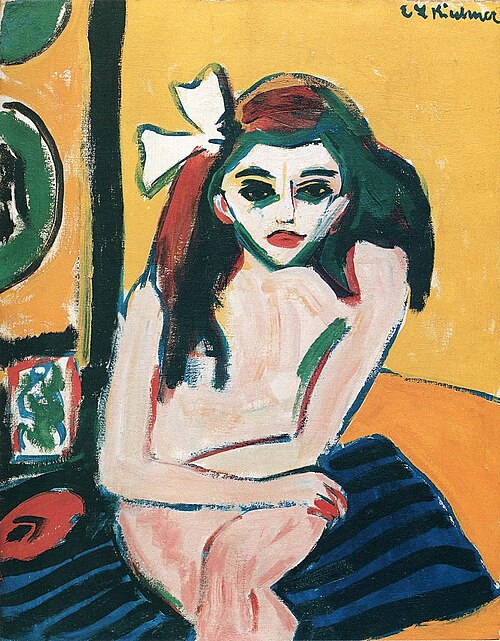
Marzella is a direct, single-figure composition. A nude girl or young figure at the threshold of adolescence is placed prominently before a yellow-orange ground.
The body is seated, with the arms closed toward the torso and the legs drawn close together. This posture makes the figure appear both visible and protective of herself. The large white bow in her hair clearly foregrounds childhood. Her face, however, is severe, with dark, direct eyes and red lips.
The dark blue striped covering below and the interior details on the left position the figure not against an empty background, but within an enclosed and disturbing interior. The composition’s power lies in the tension between the figure’s small body and the prematurely adult expression upon her face.
Three-Level Analysis through Panofsky’s Method
Pre-iconographical Level
The painting shows a nude young girl seated with a white bow in her hair. The background is yellow-orange, and the figure sits upon a dark blue striped surface.
A dark vertical field and several rounded forms on the left suggest an interior setting.
Iconographical Level
The title identifies the figure by an individual name: Marzella. This removes the painting from being a general nude composition and connects it with a particular child or adolescent figure.
The white bow evokes childhood, while the nude body suggests vulnerability and exposure. The severe facial expression and the harsh use of colour resembling makeup, however, open an unsettling field between childhood and prematurely sexualised visibility.
Iconological Level
The work reveals how the child’s body can no longer remain an uncomplicated image of innocence within modern society. Kirchner presents not only the disturbance of innocence, but also the way the gaze itself can become contaminating and oppressive.
The figure is neither a carefree child nor fully an adult. This state of suspension establishes the painting’s ethical and aesthetic tension.
Representation – Gaze – Void
Representation
The body is not idealised. Rather than softening the figure, Kirchner constructs her through fragile and linear forms.
The flesh does not carry natural colour. White, pink, greenish tones, and dark lines intensify the body’s vulnerability.
Nudity does not belong here to the traditional regime of beauty associated with the classical nude. Instead, the painting conveys the weight of being left exposed, unprotected, and visible.
Gaze
Gaze forms the painting’s most severe core. Marzella looks directly toward the viewer.
This gaze is neither secure nor inviting. It appears defensive, prematurely hardened, and disturbing. The viewer cannot remain within a comfortable position of spectatorship.
The figure is small and vulnerable, yet her gaze turns this vulnerability back toward the spectator. The painting consequently places the act of looking under ethical pressure.
Void
The background is largely constructed as a flat yellow-orange field. This openness pushes the figure forward, but offers her no relief.
On the contrary, she appears fixed before a luminous and exposed surface. The dark section on the left and the blue striped surface below further restrict this openness.
Void signifies not freedom, but the stage of exposure.
Style – Type – Symbol
Style
Kirchner’s style is clearly Expressionist. The colours do not imitate natural appearance, but construct emotional tension.
Black contours, severe facial features, and the flattened surface make the figure visible in a manner that appears both childlike and merciless. Style does not calm the body, but makes it more sharply exposed.
Type
Although Marzella is an individual portrait, she also becomes the type of the vulnerable modern child.
She belongs neither to an innocent world of play nor to the established type of the adult woman. This state of being between stages makes the figure more disturbing.
Symbol
The white bow is the clearest sign of childhood. Beside it, the dark eyes and red lips create an unsettling impression of premature adulthood.
The yellow background illuminates the figure but does not protect her. It carries the severe light of visibility.
The blue striped covering intensifies the bodily solitude of the figure and the coldness of the setting in which she sits.
Art Movement
Art Movement: Expressionism.
The severe line, unnatural use of colour, psychologically tense construction of the figure, and unsettling prominence of the gaze clearly position the painting within German Expressionism.
Conclusion
Marzella is one of Kirchner’s fundamental works demonstrating how mercilessly he could construct the modern figure.
Childhood is not presented as a secure, gentle, and protected realm, but as a threshold made vulnerable beneath the gaze. The painting’s power lies in leaving the body exposed not only physically, but ethically.
What ultimately remains is not merely the portrait of a child, but a disturbing figure revealing the severe effect of the modern gaze upon innocence.
