




Introduction to the Artist
Erró is one of the artists who, from the second half of the twentieth century onward, emerged as one of the most intense and collision-driven figures of Pop Art. In his painting, the world does not appear within a single scene or style; comic strips, advertising, political posters, cinema, consumer culture, and remnants of historical imagery rub against one another on the same surface. Erró’s paintings are therefore important not only for “what they depict,” but also for the visual memories they activate simultaneously. The Dream is a dense example of this logic from his later period: here, the dream appears not as the individual’s inner world, but as a crowded montage constructed in the mind by cultural images.
Introduction to the Work and Composition
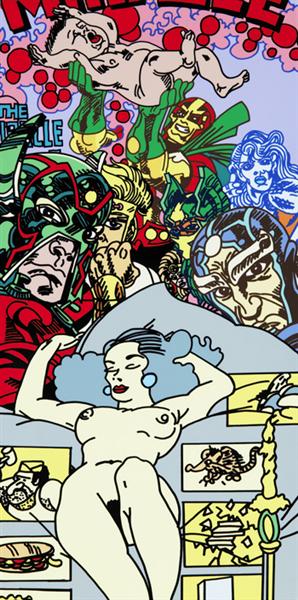
The composition is vertically organised and produces a visual crowd that accumulates in layers from the lower section upward. At the bottom lies a nude female figure reclining on a bed or sofa. Her head rests on a pale blue pillow, one arm is raised above her head, and her eyes appear closed or distant. Her red lips and blue earrings make the figure both simple and stylised. Small objects, drawer surfaces, and interior details appear around the bed, producing the sense of a private room.
Above and behind the woman, however, another universe opens: different faces, masked or armoured figures, heroic bodies evoking comic-book aesthetics, linear female faces, and clusters of letters rising toward the top cover the pictorial surface. At the very top, a baby-like or toy-like figure can be discerned lying horizontally against a white ground. The composition is therefore divided into two principal zones: the sleeping body below and the crowd of popular images filling the mind above. The central tension of the work arises from the silent merging of these two fields.
Three-Level Analysis through Panofsky’s Method
Pre-iconographical Level
In the lower section of the painting, a nude woman is reclining on a pale-coloured bed or sofa. Small household objects and decorative details appear around her. The upper section contains numerous faces, heads, masked figures, comic-book-like characters, and fragments of colourful background. At the very top lies a horizontally positioned baby-like figure. The surface as a whole is constructed through bright areas of colour and thick black contours.
Iconographical Level
The title directly names the image as a “dream.” The sleeping or resting woman can be read as the dreaming subject, while the crowd of popular figures above represents not the unconscious itself, but the images of mass culture accumulated in memory. Figures resembling comic-book heroes function like sources of modern mythology. The baby-like figure at the top may evoke a more distant, primordial layer of the dream associated with childhood. The relationship between the interior and the visual crowd opens a connection between private space and the bombardment of public images.
Iconological Level
Erró does not construct the dream here as a romantic, pure, and personal inner world. On the contrary, the dream becomes a field in which the visual debris, consumer culture, and popular mythology embedded in the mind of the modern subject come together. The sleeping body does not stand alone; heroes, faces, and clichés of the culture industry surround it. The painting thus suggests that even the dreams of the contemporary subject no longer belong solely to the individual, but have been occupied by socially produced images.
Representation – Gaze – Void
Representation
What is represented in this painting is not merely a woman and her dream. The primary representation is the contemporary form of dreaming: the collision between an individual inner world and a mass repository of images. While the female figure creates a bodily and silent centre, the faces and figures above fragment the field of representation. The dream therefore ceases to be an inward landscape and becomes a shared stage for images of media, desire, violence, and entertainment.
Gaze
The regime of gaze is one of the painting’s most important cores. The woman below has closed her eyes or withdrawn from the external world; by contrast, the faces and masked characters in the upper section are awake, severe, and outward-facing. Some appear to look directly at the viewer, while others turn toward different directions within the painting. This prevents the viewer from remaining in a passive position of observation; the eye continually moves between the private body below and the aggressive crowd of popular images above. The sleeping body does not return the gaze, but the figures surrounding it compress the viewer.
Void
There is little actual void within the painting. The surface is almost completely filled. Only the pale area on which the woman lies and the space around the pillow provide a brief opportunity to breathe. Yet even this area is immediately occupied by the crowd of figures above. Void is not a peaceful openness here; it represents a mental field of dreaming that can no longer remain empty and is continually filled with images.
Style – Type – Symbol
Style
The work clearly draws upon the language of Pop Art, yet carries a collagist and densely layered surface logic rather than the cool distance of classical Pop Art. Thick contours, flat fields of colour, comic-book aesthetics, and fragmented arrangements of figures are typical visual strategies in Erró’s work. Style cannot be separated from content here; the scattered, collision-driven, and noisy surface also determines the structure of the dream.
Type
The sleeping nude woman approaches the type of the dreaming or displayed body frequently encountered in the history of painting. The masked heroes, faces, and fantastic figures above are types belonging to contemporary mass mythology. The baby-like figure creates an impression of childhood or regression. These types function less as individuals than as carriers of cultural roles.
Symbol
The bed and pillow symbolise sleep, intimacy, and vulnerability. The nude body carries fragility as much as desire. The armoured or masked figures above symbolise the aggressive and invasive face of popular culture. The baby-like figure at the top may be read as a primordial dream, innocence, or the childhood layer of the unconscious. The symbolic force of the entire composition lies in transforming the dream from a pure inner world into a field of cultural occupation.
Art Movement
The work is not merely an example of Pop Art in the narrow sense of using popular objects; it stands closer to a later collagist form of figurative Pop Art that superimposes fragments from comic strips, media, and visual archives.
Conclusion
The Dream intensely demonstrates how Erró conceives the inner world of the subject in the age of visual culture. Here, the dream is not a personal refuge, but a field of consciousness surrounded by media images. The sleeping female figure establishes a centre associated with silence and the body, yet this centre is immediately occupied by the popular faces, heroes, and visual fragments surrounding it. The power of the work lies precisely here: rather than romanticising the dream, it makes visible how the contemporary mind has become filled with images and can no longer remain alone even within its dreams.
